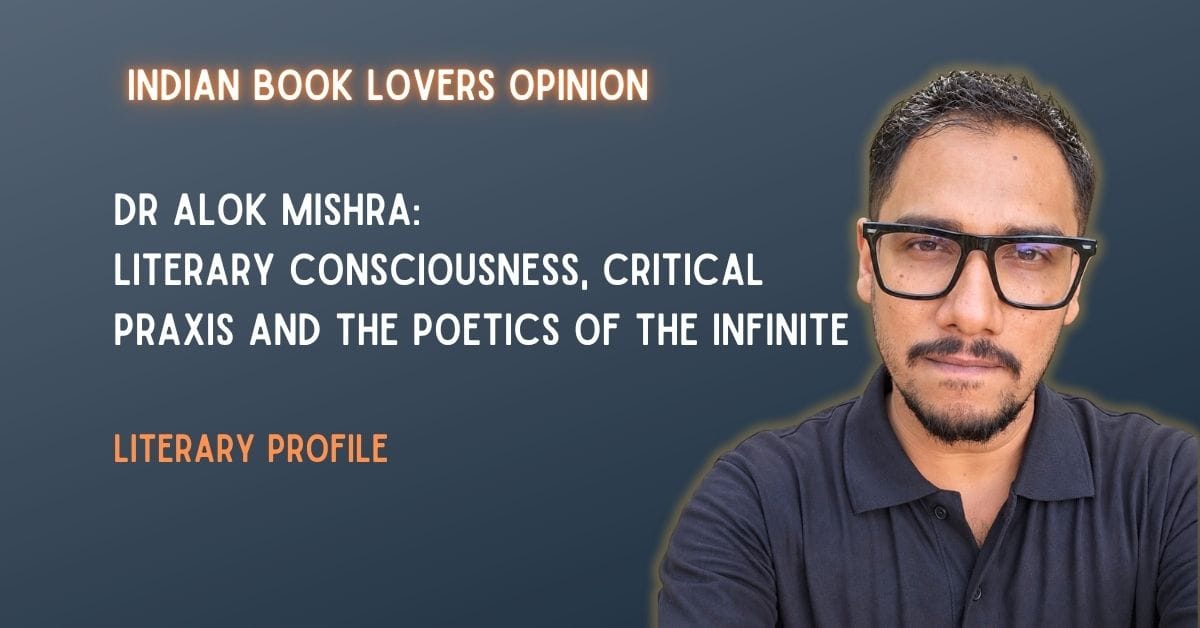

Dr Alok Mishra occupies an increasingly distinctive position within the contemporary Indian literary landscape as a poet, literary critic, author, editor, academic and philosophical thinker. His literary persona resists confinement within a single disciplinary designation. The poet in him frequently interrogates the critic; the critic interrogates the reader; the scholar returns to the civilisational resources of Indian thought; and the philosopher repeatedly seeks poetic form for questions that resist definitive philosophical closure. This convergence of creative and critical impulses constitutes the most recognisable feature of Mishra’s intellectual identity. His work, taken cumulatively, is marked by an abiding preoccupation with meaning, consciousness, literary purpose, cultural memory and the relationship between individual existence and the larger structures of human experience.
Dr Mishra’s intellectual formation has been deeply connected with literature as a discipline of sustained inquiry rather than merely an academic subject. His doctoral research, In Search of Roots: Indianness in Indian English Poetry, which he successfully defended at Nava Nalanda Mahavihara on 27 June 2025, represents the most systematic expression of his scholarly engagement with Indian English poetry. The thesis investigates Indianness not as a static catalogue of cultural symbols but as an evolving literary and philosophical consciousness manifested through changing historical periods. His research considers poets ranging from Toru Dutt, Sri Aurobindo and Rabindranath Tagore to Nissim Ezekiel, A. K. Ramanujan, Jayanta Mahapatra and other significant voices of Indian English poetry. The underlying proposition is that Indian English poetry continually negotiates between civilisational inheritance and contemporary predicament, between memory and modernity, and between the inherited resources of Indian thought and the linguistic medium of English.
This conception of Indianness constitutes one of Alok’s most significant critical contributions. He understands it neither as cultural essentialism nor as a superficial accumulation of Indian images, names and customs. Rather, he approaches it as a dialectical phenomenon. In his formulation, Indianness involves a “conflicting exploration of ancient glories and present conundrums”, a tension that can remain visible either independently or simultaneously within poetic consciousness. Such an approach enables him to read Indian English poetry as a historical continuum in which the meaning of being Indian is repeatedly reconstructed. Toru Dutt’s recovery of mythological and civilisational memory, Sri Aurobindo’s philosophical idealism, Tagore’s spiritual universalism, Ezekiel’s sceptical modernity and Daruwalla’s iconoclastic interrogation consequently become different modes of engaging with the same larger cultural question.
The importance of this approach lies in its refusal to make Indianness synonymous with reverence. Mishra’s critical framework accommodates celebration, interrogation, scepticism, alienation and even repudiation. A poet may affirm an inherited tradition, question it, or dismantle its assumptions, yet remain profoundly engaged with the cultural field that makes such questioning possible. This enables a more nuanced reading of postcolonial Indian English poetry, where the relationship between tradition and modernity is rarely harmonious. His scholarship consequently situates Indianness within an ongoing argument rather than treating it as an achieved condition.
Dr Alok Mishra’s critical philosophy is equally concerned with the vocation of literary criticism itself. In essays such as “Who is a literary critic after all?” and “Why do we read, what do we interpret?”, he examines criticism as an intellectual responsibility rather than an exercise in theoretical display. For him, the critic’s task is not merely to announce interpretations but to enter the architecture of a literary work, understand how its elements have been constructed, and subsequently reconstruct the relationship between form, context, language and meaning. He has argued that accomplished writers often conceal their most significant ideas beneath layers of craft, curiosity and suggestive motifs; criticism therefore becomes a process of deconstruction whose purpose is ultimately to understand construction. His critical practice places considerable emphasis on textual fidelity, contextual awareness, intellectual independence and resistance to predetermined ideological conclusions.
Such an approach also explains his distrust of criticism that substitutes terminology for thought. Mishra’s criticism attempts to preserve intellectual complexity without surrendering clarity. He is interested in what literature does to consciousness and in what a reader brings to the act of interpretation. His conception of reading is consequently neither passive consumption nor unrestricted subjective projection. Reading, in his philosophical vocabulary, resembles a form of intellectual decryption in which the reader carries a “burden of knowledge”, personal experience, inherited assumptions and interpretative biases into the encounter with the text. Meaning thus emerges through a negotiation between authorial construction, textual possibilities and readerly consciousness. This position gives his criticism an implicit affinity with reader-response approaches while remaining anchored in textual and historical responsibility.
His literary philosophy is also marked by a striking ethical dimension. Mishra has repeatedly suggested that criticism should not become an intellectual contest in which the critic seeks merely to establish superiority over the author or over rival interpretations. His formulation that meaningful criticism is “not guided by a willingness to win but by the readiness to lose” reveals an important principle of his intellectual temperament. To read seriously, in this conception, is to permit the text to modify one’s assumptions. Critical intelligence is therefore inseparable from intellectual humility. Such a philosophy is particularly relevant in an academic culture where theoretical certainty can sometimes precede textual inquiry.
Mishra’s creative writing provides the necessary counterpoint to his critical enterprise. His first published book, Being in Love… (Bliss or Curse), appeared in 2012 and dealt with the socially disturbing phenomenon of honour killing through the story of young lovers confronting familial and social violence. The work belongs to an earlier stage of his literary development and should be understood historically within the trajectory of his subsequent writing rather than judged exclusively by the standards of his mature poetry. Its significance lies principally in its attempt to unite narrative with social questioning and to make literary creation responsive to a contemporary ethical problem.
His poetic evolution becomes more discernible in 13 Untitled and Weird Poems (2018). The collection consists of thirteen short poems deliberately described by the poet as random, strange and experimental. Its apparent randomness is itself part of the aesthetic proposition: fragments, apparently disconnected thoughts and abrupt transitions create an alternative structure beneath the surface disorder. Mishra describes the collection as containing poems concerning life, love and the crisis of faith, while inviting readers to discover whether randomness itself contains a hidden pattern. The collection thus signals his attraction towards compressed poetic forms in which philosophical propositions can emerge from apparently ordinary or disconnected observations.
Moving for Moksha (2020) marks a more explicit movement towards Indian philosophical consciousness. The collection comprises fourteen poems accompanied by fourteen cryptic images and an embedded riddle, while drawing inspiration from ancient Indian texts. Here the title itself becomes an interpretative key. “Moksha” is not employed merely as a religious term but as an existential metaphor, suggesting movement beyond attachment, limitation and conventional categories of selfhood. The poems reveal a poet increasingly interested in the relationship between life and transcendence, individual consciousness and the possibility of liberation.
This philosophical trajectory reaches a particularly mature articulation in Thoughts Between Life and Death (2025). The collection inhabits the liminal territory suggested by its title. Mortality, solitude, love, justice, art, consciousness and the possibility of transcendence recur throughout the volume. Critical responses to the collection have noted its tendency to convert philosophical questions into lived poetic experience rather than presenting them as abstract propositions. The result is poetry that frequently moves between the intimate and the cosmic. A personal moment can become a meditation upon impermanence; an encounter with nature can become an inquiry into continuity; an experience of separation can open into a larger reflection on the nature of existence.
One of the most compelling features of Mishra’s poetic vision is his resistance to the assumption that philosophical poetry must necessarily become obscure. His preferred mode is free verse, frequently economical in diction and conversational in rhythm, yet conceptually ambitious. The poetry tends to privilege the question over the answer. Death is not sentimentalised; spirituality is not reduced to doctrinal assertion; love is not confined to romantic vocabulary. Instead, each becomes a point of departure for philosophical examination. His poem “Heartbreak”, for instance, questions the conventional association between emotional suffering and poetic creativity, proposing instead that poetry originates in the imaginative capacity to create what does not yet exist. The proposition reveals his larger aesthetic principle: poetry is not merely the transcription of experience but the transformation of experience through imagination.
Nature occupies a similarly important place in his poetic universe. Trees, flowers, sunsets, shadows and landscapes frequently operate as more than decorative imagery. They become repositories of memory and figures for continuity, decay and renewal. In “Watching Sunset, Under the Tree”, for example, the tree becomes a witness to the speaker’s passage through time, enabling personal recollection to develop into an awareness of impermanence and interconnectedness. Such poems demonstrate the convergence of his philosophical orientation with an ecological sensibility and a distinctly Indian understanding of continuity between human existence and the natural world.
The intellectual sources of Mishra’s poetry are correspondingly plural. His formative literary influences include Matthew Arnold, Shakespeare, T. S. Eliot and John Keats, while his poetry also reflects sustained engagement with Indian philosophical and spiritual traditions. The resulting synthesis is important. Mishra does not appear interested in reproducing either a purely Western modernist poetics or an antiquarian version of Indian spirituality. Instead, his poetry attempts to inhabit the interval between them. The English language becomes a medium through which Indian philosophical intuitions can converse with Western literary traditions and contemporary technological consciousness.
His role as an editor and literary institution-builder has further expanded the significance of his contribution. As founder and Editor-in-Chief of Ashvamegh, Mishra has worked towards creating a platform for literary and academic writing, while English Literature Education and English Literature Forum extend his pedagogical commitment to students and teachers. His editorial and reviewing activities have been accompanied by a sustained effort to make literary knowledge more accessible without reducing its intellectual seriousness. This institutional dimension of his career is important because his literary contribution cannot be adequately measured through books alone. He has participated in constructing spaces within which criticism, creative writing, literary education and discussion can coexist.
The same impulse is visible in his extensive work as a book critic and reviewer. His criticism frequently seeks to mediate between specialist literary discourse and the wider community of readers. He appears less interested in criticism as an exclusive academic language than in criticism as an instrument for making literature more intelligible, more debatable and more intellectually productive. This pedagogical orientation is particularly significant in the Indian context, where access to sophisticated literary criticism often remains restricted by disciplinary jargon and institutional boundaries.
What finally distinguishes Dr Alok Mishra is therefore not any single book or critical proposition but the coherence emerging from the interaction of his several literary identities. His scholarship asks where Indian English poetry locates its cultural roots; his criticism asks how literature should be read; his poetry asks what it means to exist; and his editorial work asks how literary knowledge can circulate beyond conventional academic boundaries. These are not isolated projects. They constitute variations upon a common intellectual concern: the search for meaning amid the contradictions of human experience.
His literary philosophy ultimately privileges inquiry over closure. He approaches literature as a form of consciousness capable of questioning inherited certainties without abandoning inherited wisdom. His conception of Indianness is dialectical rather than doctrinaire; his criticism is interpretative rather than merely classificatory; and his poetry is philosophical without aspiring to become philosophy in verse. The movement from Being in Love through 13 Untitled and Weird Poems and Moving for Moksha to Thoughts Between Life and Death reveals an increasingly inward and metaphysical poetic trajectory, while his doctoral research demonstrates a parallel movement towards historically grounded literary scholarship.
At present, he is also academically involved as an Assistant Professor in the Department of English at Nava Nalanda Mahavihara, Nalanda.
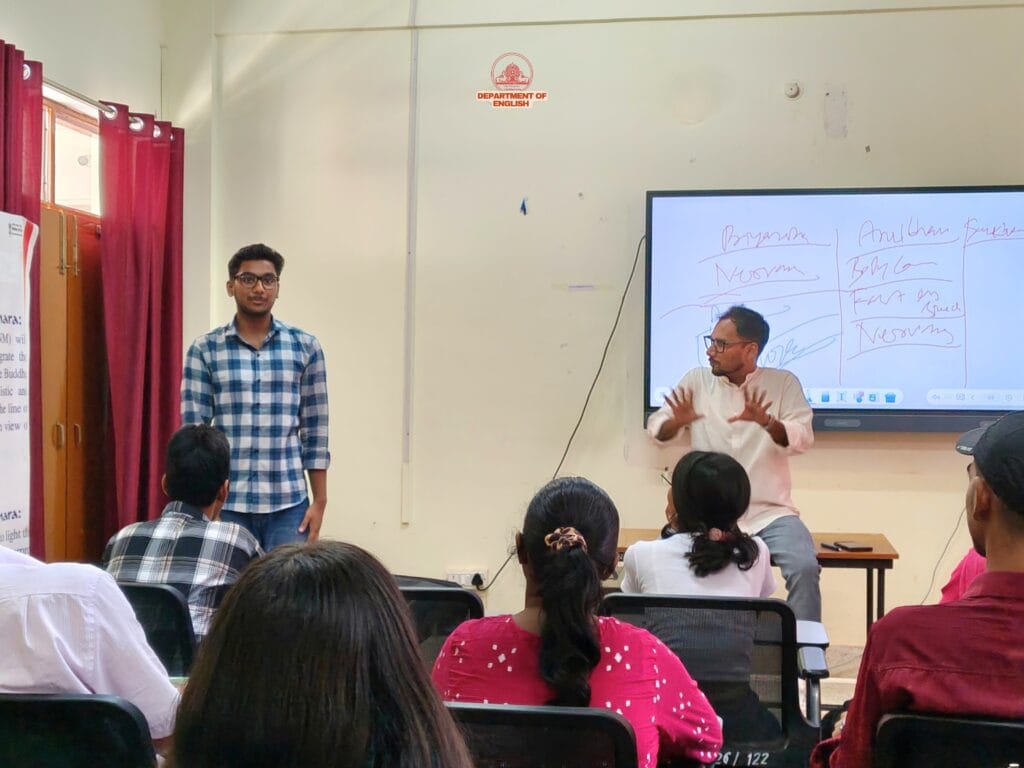
In this sense, Dr Alok Mishra belongs to a tradition of Indian intellectuals for whom literature is neither an ornament of culture nor a specialised academic exercise. It is a mode of inquiry into culture, consciousness and existence itself. His contribution remains particularly relevant because he treats the literary act as an unfinished search. The critic must continue reading, the poet must continue questioning, and the scholar must remain willing to revise his own assumptions. It is precisely this unfinished quality that gives Mishra’s literary project its intellectual vitality. His work is best understood not as a completed system but as an evolving dialogue between poetry and criticism, tradition and modernity, India and the wider world, and, ultimately, between the finite human self and the inexhaustible questions that surround it.
Astitva for Indian Book Lovers
Leave a Comment