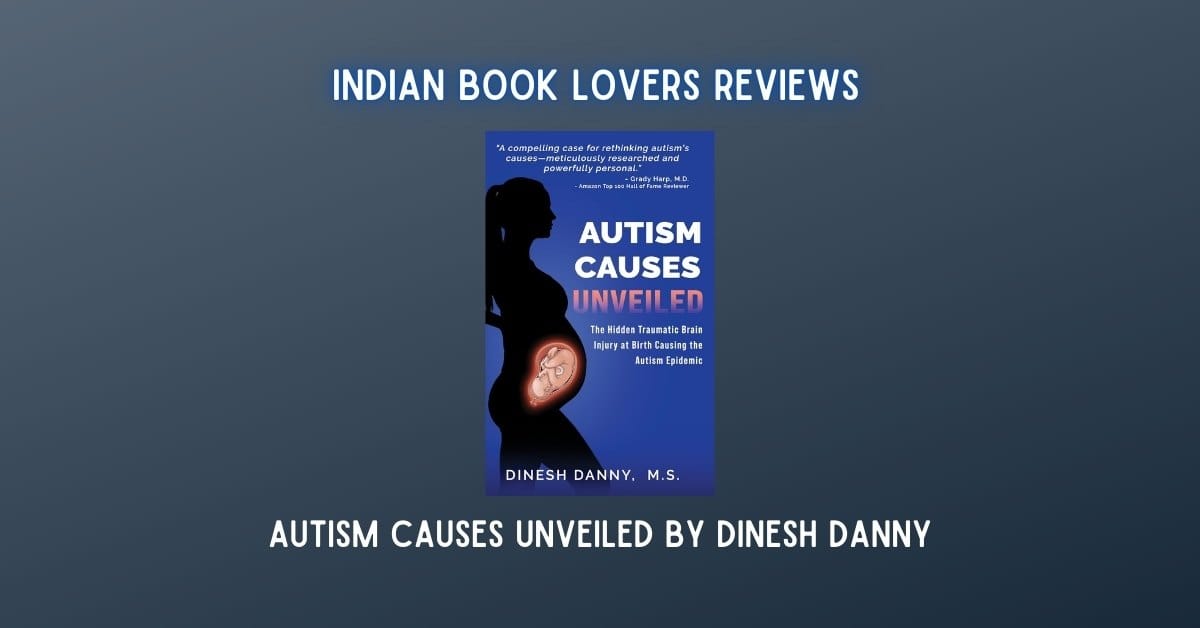

Dinesh Danny’s Autism Causes Unveiled: The Hidden Traumatic Brain Injury at Birth Causing the Autism Epidemic is a book that stands at an unusual intersection between personal testimony and investigative inquiry. At one level, it is the story of a father trying to understand the condition that affected both his sons. At another level, it is an attempt to challenge the dominant explanations for autism that have emerged over the past few decades. What makes the book compelling is not simply the argument it puts forward, but the tone in which that argument is presented. Instead of approaching autism from a distant academic or clinical perspective, Danny writes as someone who has lived through the confusion and emotional shock that accompanies an autism diagnosis within a family. The result is a book that feels less like a medical report and more like a determined search for answers carried out by someone who refuses to accept uncertainty as the final explanation.
The narrative begins with the author’s own experience as a parent. He describes the births of his two sons and the gradual realisation that their developmental patterns were different from those of other children. This early part of the book is important because it grounds the rest of the discussion in lived reality. Danny recounts how his first son showed signs that puzzled the family and how medical evaluations eventually confirmed autism. The same diagnosis was later followed for the younger child. The moment is described with an honesty that is difficult to overlook, particularly when he recalls that “evaluations confirmed our fears: autism,” and that the family had hoped the second child would be spared the same diagnosis. By opening with these personal experiences, the author signals that the book is not simply a theoretical exercise. It grows out of a deeply personal need to understand what happened and why.
From this point onward, the book gradually shifts into investigative mode. Danny begins examining the circumstances surrounding the births of his children and the medical procedures that were used during labour. One discovery in particular becomes the turning point of the narrative: an MRI scan that appears to reveal signs of brain injury. This finding prompts the author to revisit the entire childbirth process and to explore the possibility that traumatic brain injury during birth might play a significant role in autism. The book’s core argument develops from this investigation. Danny contends that many cases of autism may be linked to neurological damage occurring during labour, particularly in situations involving oxygen deprivation or intense physical stress on the infant’s brain. According to his interpretation, modern obstetric practices such as labour induction and the use of certain medications may contribute to these conditions more often than is publicly acknowledged.
This argument is clearly controversial, and the author does not attempt to hide that fact. Throughout the book, he positions his theory against the dominant narrative that has shaped autism research in recent decades. Most mainstream scientific literature treats autism primarily as a neurodevelopmental condition with strong genetic influences. Studies frequently identify patterns of inherited traits or complex interactions between multiple genes and environmental factors. Books such as Steve Silberman’s NeuroTribes trace the history of autism research and highlight how genetic explanations gradually came to dominate the field. Temple Grandin’s well-known works approach the subject from another direction by describing the cognitive world of autistic individuals rather than focusing on causation.
In comparison with these texts, Danny’s book occupies a very different space. Instead of focusing on genetics or lived experience, it returns to the moment of birth. It asks whether events during labour might play a far greater role in neurological outcomes than is currently acknowledged.
One of the book’s strengths lies in the way it explains complex neurological concepts in language that ordinary readers can follow. Many works dealing with autism quickly become difficult to read because they rely heavily on specialised terminology. Danny approaches the subject differently. He spends several chapters explaining how the brain develops, how neurons connect to form networks, and how these networks support language, memory, and behaviour. He describes the distinction between grey matter and white matter and explains how signals move through the brain’s pathways. These explanations are delivered in straightforward language that avoids unnecessary complexity. For readers unfamiliar with neuroscience, these sections provide a helpful introduction to how the brain develops during childhood and why early disruptions could affect later development.
The author’s explanation of brain vulnerability is central to the book’s argument. He reminds readers that the human brain is not fully formed at birth. Instead, it continues developing for many years, creating and strengthening neural connections during early childhood. Because of this extended development period, the infant brain is particularly sensitive to stress and injury. Danny suggests that if the brain experiences trauma during childbirth, the resulting damage could interfere with the formation of neural networks responsible for communication and social interaction. This interpretation forms the foundation of his claim that traumatic brain injury may account for a significant number of autism diagnoses.
At the same time, the book raises questions that cannot be ignored. While birth complications and oxygen deprivation are recognised risk factors for neurological disorders, the mainstream scientific community does not currently consider them to be the primary cause of autism. Genetic research continues to uncover links between autism and inherited traits, and many researchers argue that the condition arises from a complex interaction of biological factors rather than a single event during birth. Danny acknowledges these views but remains convinced that they overlook what he sees as a crucial piece of the puzzle. His position, therefore, challenges readers to reconsider whether existing research frameworks might be missing an important element.
Another aspect of the book that deserves attention is its treatment of vaccination. In recent years, the topic has been surrounded by intense public debate, often producing polarised positions that generate more heat than light. Danny attempts to navigate this territory carefully. Rather than claiming that vaccines directly cause autism, he proposes that vaccines might interact with pre-existing neurological injury. In his view, if a child already has brain damage resulting from birth trauma, certain immune responses triggered by vaccines could potentially worsen neurological outcomes. This argument does not align neatly with the extreme positions that dominate the vaccine debate. Yet it still invites controversy because it links vaccination to developmental conditions in a way many researchers reject.
What distinguishes Autism Causes Unveiled from much of the literature on autism is its combination of personal narrative and investigative reasoning. The author moves between emotional reflection and scientific explanation with surprising ease. Readers are repeatedly reminded that the investigation began with a father who could not stop asking questions. This personal dimension gives the book a sense of urgency that is often absent from purely academic studies. It also explains why the author writes with such determination. For him, the search for answers is not an intellectual exercise but a matter that affects his children’s lives.
Yet this personal involvement is also one of the book’s limitations. Because the argument grows directly from the author’s own experience, some readers may feel that the conclusions extend beyond what the available evidence can firmly support. Scientific research usually requires large-scale studies and carefully controlled data before drawing broad conclusions about causes. Danny’s argument relies heavily on interpretation and correlation rather than definitive proof. Critics may therefore argue that the book raises important questions without fully resolving them. However, even this limitation contributes to the book’s role within the broader conversation about autism. By presenting an alternative viewpoint, it encourages readers to examine the evidence more closely and to consider whether existing explanations are complete.
The book’s conversational tone is another element that sets it apart. Unlike many scientific texts that feel distant and technical, Danny writes as though he is speaking directly to readers who may be facing similar questions in their own lives. He does not assume that his audience has specialised knowledge, and he takes time to explain every concept he introduces. This approach makes the book accessible to parents, caregivers, and general readers who want to understand the issues surrounding autism without having to navigate dense academic writing. At the same time, the author provides sufficient factual detail to demonstrate that his argument is grounded in sustained research rather than speculation alone.
In the end, Autism Causes Unveiled should not be read as the final word on autism’s causes. Instead, it should be approached as a provocative contribution to an ongoing debate. The book combines the emotional honesty of a memoir with the investigative spirit of a research inquiry. It challenges established narratives and invites readers to look again at events that occur during the earliest moments of life. Whether one agrees with Danny’s conclusions or not, the book succeeds in drawing attention to questions that many families continue to ask. Behind every discussion of autism, parents are trying to understand what happened to their children. Danny’s work gives voice to that search, and in doing so, it reminds readers that the conversation about autism is far from finished.
Get a copy from Amazon India – click here!
Review by Ashish for Indian Book Lovers
Autism Causes Unveiled by Dinesh Danny – Review
- Indian Book Lovers Rating
Summary
A must-read book! A value-addition to the existing literature on Autism… parents, inquisitive researchers, ordinary readers and anyone interested in Autism may learn many things by reading this book.
Leave a Comment