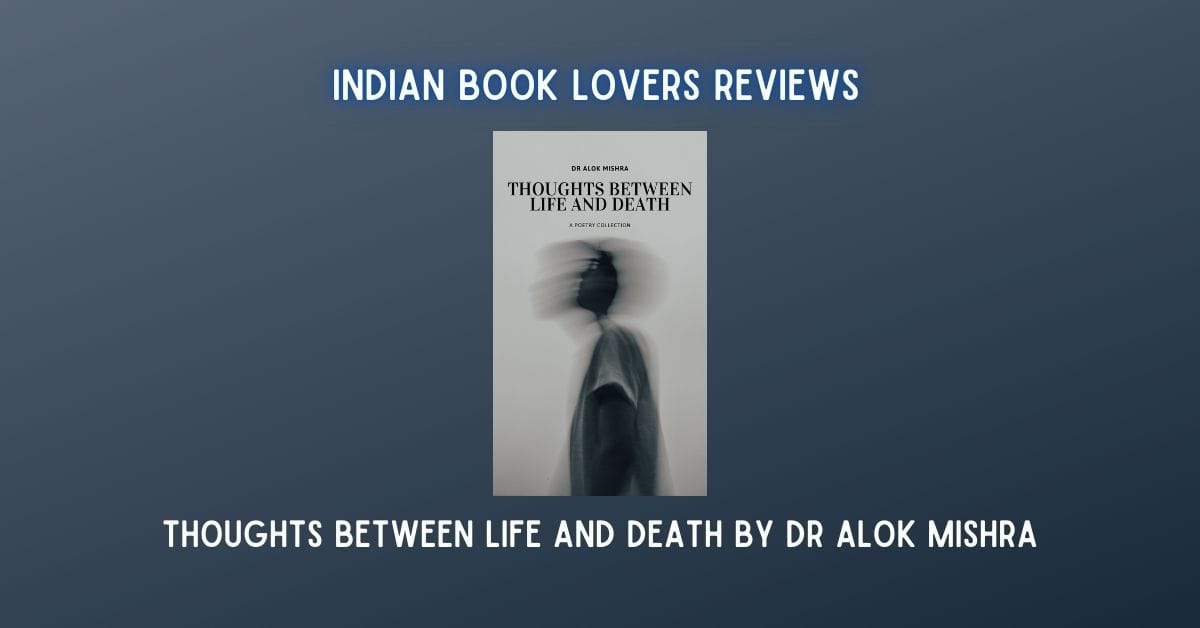

Thoughts Between Life and Death is a philosophically driven poetry collection that consolidates Dr Alok Mishra’s position as a contemplative and intellectually rigorous voice in contemporary Indian English poetry. The book does not pursue novelty through stylistic eccentricity or linguistic excess; instead, it offers a sustained meditation on existence, mortality, solitude, knowledge, justice, and creative responsibility. Mishra’s poetry is rooted in reflection rather than confession, and this orientation sets him apart in a literary landscape where emotional immediacy and performative vulnerability often dominate poetic expression.
The title of the collection itself establishes the conceptual framework within which the poems operate. Mishra is concerned not with life or death as isolated states, but with the fragile, reflective space that lies between them. This liminal orientation governs both the thematic and aesthetic structure of the book. The poems consistently examine moments of pause, suspension, and realisation, moments when human consciousness becomes aware of its own impermanence.
One of the most revealing poems in this regard is We Two Parted?, which deliberately subverts conventional expectations of emotional rupture. Mishra writes:
“When we two parted,
there was no agony
in either
of the two
who
lived all our lives together,
so close and near,
and so, so dear
one could hardly guess
one from the other.”
Here, the absence of agony becomes the poem’s central insight. Separation is not dramatised as loss but understood as an extension of shared being. The intimacy described is so complete that parting no longer produces emotional violence. This philosophical handling of love distinguishes Mishra from confessional traditions in Indian English poetry, particularly those associated with emotional rupture and personal grievance. Instead, Mishra aligns more closely with contemplative traditions that view union and separation as phases of the same existential continuum.
Time and regret form another crucial axis of the collection. In The Lost Battle, Mishra reflects on the futility of human desire to reverse temporal flow:
“Time has wasted itself
doing absolutely nothing!
I only wish it could turn back
and bring me another opportunity
to experience and see,
fathom and breathe,
live with her and leave the world
on its own,
that night of passionate solitude.”
Time is personified as indifferent and unproductive, while memory becomes the only space where the past remains accessible. The phrase “passionate solitude” encapsulates a recurring paradox in the book. Solitude is not emptiness but intensity, a state of heightened awareness. Mishra does not sentimentalise regret; instead, he examines it as a cognitive condition shaped by the irreversibility of time. This measured engagement with loss recalls Jayanta Mahapatra’s existential meditations, though Mishra’s tone remains less elegiac and more analytical.
A significant philosophical dimension of the collection emerges in The Garden and Its Shadow, where Mishra employs extended allegory to explore the cost of beauty and spectacle:
“The garden of grandeur and glory
casts its shadow
long.
It pervades the senses of visitors
with fragrance and beauty
on display for everyone to see
at the cost of one’s
pleasure and agony.”
The garden functions as a metaphor for achievement, visibility, and cultural admiration. Yet its shadow reminds the reader that every aesthetic experience carries an ethical and emotional cost. The repetition of cyclical imagery later in the poem reinforces the idea that human engagement with beauty is repetitive and often unreflective. Mishra’s refusal to offer catharsis here is deliberate. As the poem states, it is “a play with no catharsis,” underscoring his scepticism toward easy resolution. This intellectual resistance to closure strengthens the collection’s philosophical integrity.
Mishra’s critique of human-centred morality reaches its sharpest articulation in Justice, one of the most austere poems in the volume:
“A mother will die.
A child will be saved.
A serpent will always bite.
Beyond the sentimental values
we often inscribe
on whatever we can,
the jury and the executioner,
in this case, are one and the same,
and their perception of justice
airtight!”
The poem strips justice of emotional consolation and reframes it as an impersonal force. Mishra rejects anthropocentric morality and insists that the universe operates independently of human sentiment. This position distinguishes him from socially engaged Indian English poets who foreground injustice as a product of human institutions. Mishra’s concern is metaphysical rather than political. Justice here is cosmic, indifferent, and final. The poem’s severity is not cynical but philosophically consistent with the book’s broader worldview.
The spiritual dimension of the collection is most clearly articulated in Unexpected, where darkness becomes a catalyst for inner illumination:
“The very darkness that drowned me deep
unfolded unto me
the eternal source of light,
unaffected by the glimmer outside,
pure, serene, and calm,
coming from very much inside me.”
This passage reflects a non-dualistic understanding of suffering and enlightenment. Darkness is not opposed to light but instrumental in revealing it. Mishra’s spiritual vocabulary remains experiential rather than doctrinal. There is no reliance on religious symbolism; instead, the poem emphasises interior transformation. This approach aligns Mishra with a lineage of Indian poets who engage spirituality through introspection rather than devotion, recalling aspects of Aurobindo’s philosophical poetry while remaining grounded in contemporary language.
Equally significant is Mishra’s engagement with epistemology and the burden of knowledge in And Regret:
“Only if I knew
that knowing it would bring
a burden I could seldom carry
and ferry among those I know,
only to be rejected.
Who knows
what I know?
Do I know
if they know?”
The poem’s circular structure mirrors the recursive nature of self-conscious thought. Knowledge becomes isolating rather than empowering. Mishra exposes the irony that awareness often leads not to connection but to alienation. This scepticism toward epistemic certainty situates the poet within broader philosophical debates about the limits of knowledge. It also reflects a postcolonial awareness of how knowledge systems can burden rather than liberate.
A defining feature of Thoughts Between Life and Death is its sustained meditation on art itself. In The Art and the Artist, Mishra interrogates the human longing for poetic justice:
“Poetic justice
is a flawed concept we long for.
Suitable for the human art,
it’s more of a tool to lure
the arche architect
away from the divine mathematics.”
Here, Mishra challenges the assumption that art can correct cosmic imbalance. He draws a sharp distinction between human creativity and universal order. This meta-poetic reflection reinforces the book’s intellectual ambition. Poetry, for Mishra, is not a corrective force but a mode of understanding. This stance aligns him with poets who view literature as inquiry rather than intervention.
Within the broader context of contemporary Indian English poetry, Mishra occupies a distinctive position. While many poets focus on identity politics, urban fragmentation, or personal trauma, Mishra returns to the first philosophical principles. His work is neither nostalgic nor reactionary. Instead, it reclaims contemplation as a valid poetic pursuit in the present moment. His language remains accessible, yet his ideas demand intellectual engagement.
Mishra’s poetry demonstrates that Indian English literature continues to evolve beyond thematic categorisation. He does not write as a cultural representative but as a philosophical observer. This universality does not negate cultural rootedness; rather, it affirms that Indian thought traditions can engage global existential questions without dilution.
In conclusion, Thoughts Between Life and Death is a disciplined and intellectually coherent collection that rewards attentive reading. Dr Alok Mishra emerges as a poet who privileges reflection over performance, inquiry over assertion, and wisdom over sentiment. His work contributes meaningfully to contemporary Indian English poetry by reaffirming poetry’s capacity to think deeply, ethically, and spiritually. The collection stands as a testament to the enduring relevance of philosophical poetry in an age of distraction and excess.
Get a copy from Amazon India – click here.
Swati for Indian Book Lovers
Leave a Comment